
Inflation was already a major issue entering 2026. Unfortunately, rising prices for goods and services have only increased over the last few months.
Conflict around the world has led to disrupted logistical chains and higher transportation costs. Couple this with an aggressive tariff policy and the result is a ripple effect increasing costs at every level of the economy.
Despite (or perhaps because of) the ever-increasing cost of living, Americans continue to spend more money on their pets than ever before. Let’s explore the cost of owning a pet in 2026 and how it’s changed since 2025.
Cost of Owning a Pet 2026 Key Findings:
- Americans spent $158 billion on pets in 2025; APPA projects $165 billion in 2026
- 95 million US households own at least one pet
- Vet prices are up ~55% since 2019 — the biggest riser of any consumer category
- Owning a dog costs $1,695–$6,025 a year (Rover, 2026)
- 1 in 7 pet owners are experiencing “pet poverty” (MetLife)
- Average pet transport cost: $0.63 per mile (CitizenShipper internal data)
Recent Trends in Pet Ownership for 2026
Increased cost of living has done little to stop Americans from pet ownership. Some of the most interesting data from the American Pet Products Association’s (APPA) State of the Industry Study 2026 include:
- Gen X was the fastest-growing pet-owning generation (25% → 28% of owners)
- Boomers were the only generation to decline (25% → 22%)
- 95 million households in the United States own at least one pet.
- Most pet owners have more than one pet – with Millennials and Gen Z leading the generation pack.
In last year’s report, we cited a LendingTree survey that found nearly a quarter of those who don’t own a pet say it’s because they can’t afford one. Estimates vary by survey — MetLife’s 2025 study found lower rates. Some notable results of the survey include:
- 1 out of 5 pet owners carry at least $2,000 in pet debt.
- Nearly double that (39%) of pet owners have gone into debt specifically for pet medical care.
- 1 in 10 pet owners have considered rehoming their pet due to financial issues; 1 in 20 have gone through with it.
- 1 in 7 pet owners (15%) are experiencing ‘pet poverty.’
Speaking of Gen Z, they are particularly affected by the cost of owning a pet. In the MetLife survey, nearly half of Gen Z respondents say they skip hobbies or activities to pay for their pets, and over a third take on extra work for the costs.
What Pet Expenses Have Increased The Most in 2026?
In 2025, Americans spent $158 billion on their pets, according to the 2026 APPA study. What categories are included in that figure, and which expenses have increased the most this year?
- Veterinary service prices have risen about 55% since 2019 — the largest cumulative increase of any major consumer category — and were still climbing 6.5% year over year as of March 2026, according to Bureau of Labor Statistics CPI data.
- While inflation is partially to blame, this rise in pet health care outpaces the rate of inflation by a wide margin.
- A main cause for the increase is more sophisticated (but expensive) veterinary care, like advanced orthopedics, dental care and teeth cleanings, and better access to oncologists for cancer treatment.
- Rover’s 2026 Cost of Dog Parenthood report finds dog-care costs are expected to rise as much as 15% this year, driven by vet prices and tariffs on pet supplies.
On one hand, these advanced treatments and care lead to pets living longer. More than half of pet owners (52%) skipped or declined recommended vet care in the past year, and 71% of them cite cost as the reason, according to the PetSmart Charities–Gallup State of Pet Care study.
Those that don’t decline care may find themselves in debt due to emergency services (i.e. accidentally ingesting something toxic) or chronic health conditions. LendingTree found that 37% of pet owners have gone into debt for their pet, 12% have surrendered a pet because they couldn’t afford it (rising to 25% of Gen Z), and 39% say they won’t own a pet again.
Vet expenses are an important consideration when you have a pet, but are far from the only costs. APPA broke pet expenses into four major categories:
- Food & Treats — $68.3 billion (+3%)
- Veterinary Care — $41 billion (+3%)
- Supplies, Medications & Live Animals — $34.4 billion (+4.4%)
- Other Services — $14.3 billion (+8%)
Why You Should Consider Pet Insurance
Medical costs are the largest pet-related expense. As profit margins become more slim, veterinarians are under increased pressure to upsell customers on additional products and services. Some of these products and services are certainly worth the cost, while others should be met with a degree of skepticism.
However, all pets get sick from time to time, have accidents or emergencies, or develop long-term conditions. All of these legitimate health concerns will cost you — and sometimes, a significant amount.
One way to avoid paying quite so much for an unexpected vet bill is to sign up for pet insurance.
- Keep in mind that co-pays aren’t common in vet care, you pay the full cost up front and then get reimbursed.
- Get insurance as soon as you bring your pet home, as pre-existing conditions aren’t covered (so get them covered before it’s pre-existing).
- Rare, but does happen: employers offering group plans for pet owners.
Location Affects Pet Costs
Location, location, location. The cost of owning a pet does vary regionally. Just like every good and service, higher cost of living areas tend to be more expensive for pet ownership. In the United States, the most expensive places to own a pet are in the west and northeast.
Buying from a Breeder Vs. Adopting from a Shelter
The biggest factor when it comes to the cost of adopting a pet is whether or not you go through a breeder. It’s more expensive to adopt a pet through a breeder for a variety of reasons:
- Dog breeding is a time-consuming, cost-intensive process with a lot of overhead.
- Breeders need to recoup expenses and turn a profit.
If you adopt through a rescue shelter or agency, you’ll pay significantly less upfront. Most rescue organizations are non-profit organizations that use the adoption fee to:
- Cover the cost of housing/feeding the animal
- Providing the animal with required medical care (vaccinations, spay/neuter surgery, microchip)
- Other operational expenses
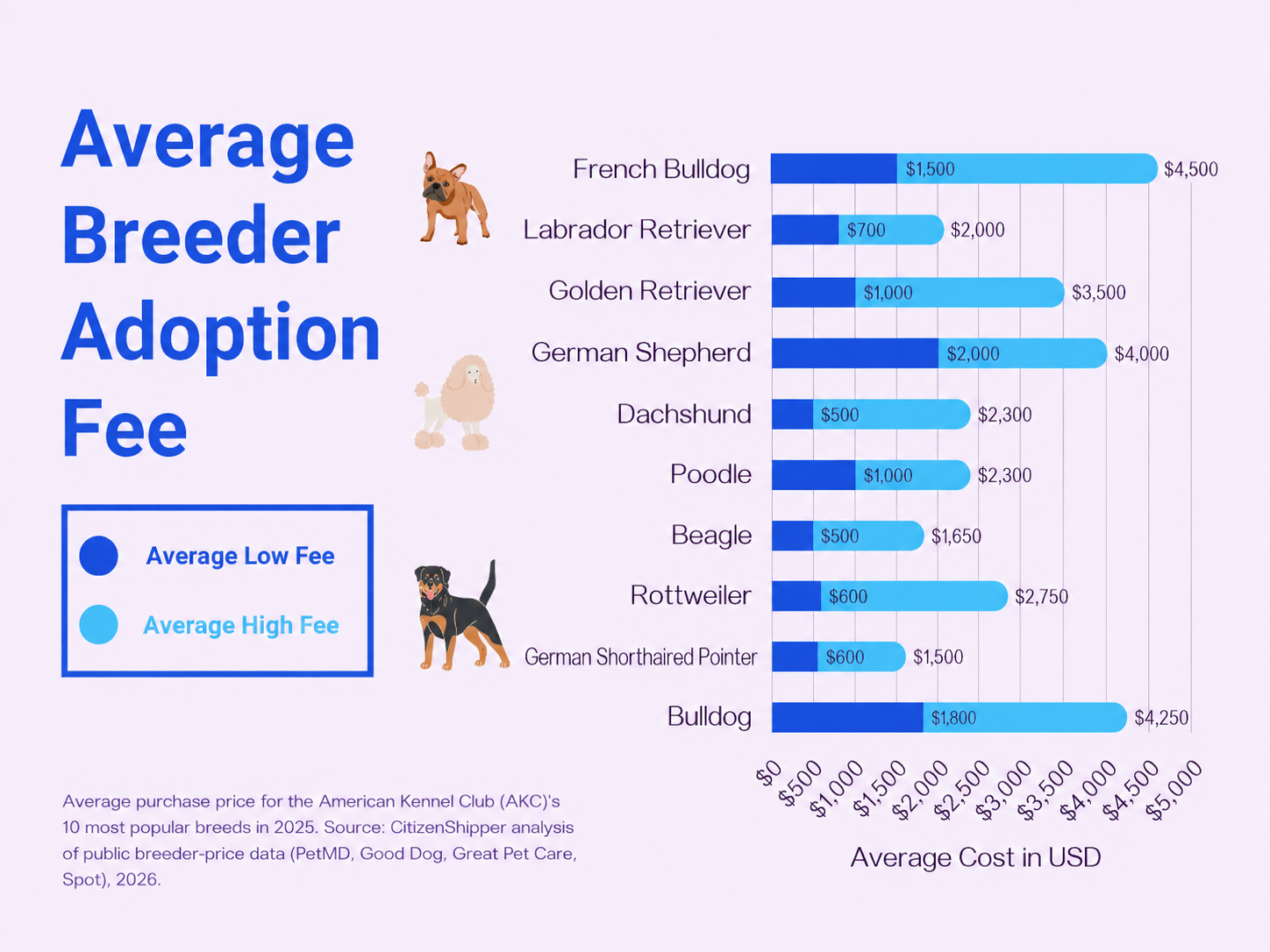
Most and Least Expensive Dog Breeds
Other Initial Cost Considerations
The adoption fee isn’t the only upfront cost you’ll have to consider when adopting a pet. MarketWatch’s Guide’s 2026 study shows that other costs include vaccinations, spaying/neutering, preventative medicine and general supplies, adding up to an average of $1,038:
- Vaccines: $199
- Spay or neuter operation: $298
- Preventative medicine: (heartworm, flea and tick, etc.): $184
- General supplies: (leashes, bowls, crates, pet beds, etc.): $356
Rover’s 2025 report puts supplies far higher (at about a $690 midpoint) while the medical categories land close to MarketWatch’s averages.
Preventatives: Keeping (You and) Your Pets Comfortable
One expense that isn’t frequently discussed but can end up making a big dent in your budget is preventatives. Preventative care covers a wide gamut, including:
- Flea and tick medication
- Disease screenings
- Neuturing/spaying
- Dental care
Parasite prevention ranges in performance depending on your lifestyle and location. If you have a large yard or even live on a range, or spend lots of time outdoors with your pets, flea and tick preventatives are going to be a quarterly expense. If you live in a city apartment and rarely spend time in grassy areas you’ll spend less on preventatives — though even in our experience as urban apartment dwellers, fleas can be insidious, especially with carpeted floors.
Cost of Flea Medication
A three-month supply of Frontline brand flea prevention treatment costs around $40 to $50 at Target. There are other brands widely available, including Advecta ($32.99 at Target), Pet Armor Plus ($42.99 at Target), Tevrapet Activate II ($26.99 at Target). Each pack includes three doses of flea medication, and each dose should last at least 30 days.
Some pet owners choose to use flea collars or simply wash with flea and tick-preventing shampoos. Capstar also makes an oral flea preventative that is almost instantly effective in killing fleas, but only lasts for up to 48 hours. With that in mind, you should plan to budget between $100 and $200 a year for flea prevention.
Puppy Transportation Costs
Most experts recommend that you meet a puppy before adoption. However, that’s not always possible. Maybe you live in a remote area or want a specific breed that’s not available locally — in that case you may need to purchase from an out-of-state breeder and pay for pet transportation.
There are, of course, other reasons to transport your pet. Some common circumstances include moving long-distance, taking a long-term vacation, or perhaps a work arrangement that finds you in another city for months or years.
The cost of pet transportation can vary. Factors include:
- The distance of the transportation
- Whether your pet travels alone or with other animals
- Seasonality
- The size of the animal
- How remote the destination is
Our internal data finds that the average cost per mile for pet transportation is $0.63 a mile. Of course, that rate can vary depending on the factors mentioned above. CitizenShipper makes it easier to get a better deal on pet transportation. This is because our marketplace allows for “trip stacking,” meaning transporters can be more efficient on their routes and therefore charge a lower rate. Additionally, when you post a listing on our pet transportation marketplace, you’ll receive multiple bids. This gives you the flexibility to find a transporter that fits your budget.
Before Taking a Vacation, Consider the Cost of a Pet Sitter
When it comes to vacations, there is the added expense of a pet sitter. The most popular dog-sitting marketplace in the United States is Rover, which offers a variety of services.
Depending on the needs of your pet, you can choose to have the sitter stay at your home, your pet stay at the sitter’s home, or have the sitter come for drop-in visits (not recommended for dogs). According to Rover, there are some factors that affect the cost of pet sitting:
- Time of year: Holidays are often the busiest times for travel, so rates are higher
- Location: Like with everything covered in this report, high cost of living areas tend to have higher pet-sitting rates
- Experience: More experienced pet sitters with higher reviews often charge a premium for their services
Cost-Effective Ways to Hire Pet Sitters
The average Rover pet sitter charges between $40 and $100 a night. Drop-in, overnight and extended care each have different rates. A drop-in visit can be as little as $20-$30 per visit, while overnight care ranges from $80-$100 a night.
We typically board our dog when we go out of town and use Rover. We have a great local pet sitter that we try to use any time we go out of town and it’s not convenient or possible to bring the dog. Our sitter charges $80 a night for boarding in an upscale apartment in a nice part of town. While she isn’t the cheapest option available, we are more than willing to pay a little extra to ensure our dog is in good hands.
For our cat, we’re a little less picky and use drop-in service. Cats are more independent and leaving them alone overnight isn’t as big of an ask as it is for a dog. When we’ve hired a cat sitter for drop-in visits, the rate was $23 a night.
Average Annual Cost of Pet Ownership
In addition to the upfront costs of pet adoption, there are costs you can expect to pay over your pet’s lifetime. Most dogs live between 10 and 13 years, while cats can live up to 20 years. The national average cost to own a dog is over $2,500 according to Market Watch.
ValuePenguin estimates the average pet household spends $1,733 a year across all pets — about $1,248 for a dog and $836 for a cat, with vet care the biggest line item.
Average Cost of Dog Ownership
In a study posted on Rover’s The Dog People Blog, the average annual cost of dog ownership ranged from a low of $1,695 per year to a high of $6,025.
One way to lower the overall cost of a pet is to adopt a young adult dog or cat instead of a puppy or kitten.
- You won’t have to pay for their vaccinations and sterilization surgery
- It’s less likely you’ll need to pay for training classes — though some adult adoption dogs come with “baggage” that will need to be worked through in training classes
- Adult dog food is less expensive than puppy food, and because the dog is no longer growing, they may eat less of it.
However, a senior dog tends to be more expensive on average than a healthy adult-age pup. They may require prescription food (more on that in detail later) or special products to aid in their quality of life. For example, as our previous dog aged, we needed to purchase foam stairs (~$50) so she could get up and down from our bed.
The Bigger the Dog, the Higher the Costs
The larger the dog breed, the more you can expect to pay on an annual basis. In fact, small-breed adult dogs can cost up to 63% less per year than large- and giant-breed dogs.
- Puppy food is more expensive than adult dog food
- You’ll visit the vet less often when you have an adult dog
- Training expenses are eliminated once your dog has completed courses
According to Rover, the average annual expense for a small dog (10-15 lbs) is just $1,390 while a medium dog (22-55 lbs) is $3,343 a year. A large dog (over 60 lbs) can cost as much as $5,295.
Cost of Owning a Pet in 2026: In Conclusion
While the cost of owning a pet continues to rise along with inflation, that hasn’t stopped more and more Americans from bringing a furry friend into their home. Despite an annual cost of between $1,700 and $6,025, the pet ownership has held steady.
With these costs it’s important to plan ahead and budget before getting a pet. Know your financial limitations and adopt a pet that fits your lifestyle and ability to pay — otherwise you may find yourself in the heartbreaking circumstance of needing to surrender your pet to make ends meet.
When you understand the cost of pet ownership, you can plan ahead to avoid cutting out hobbies and vacations, or taking on large amounts of debt.
Frequently Asked Questions
How much does a dog cost per year in 2026?
Rover’s 2026 study found that the average annual cost to own a dog ranges from $1,695–$6,025 a year.
How much does a cat cost per year?
Rover conducted a 2026 study on the annual cost of cat ownership. Their study found that a kitten costs between $840 and $3,665 a year while an adult cat ranges from $850 to $4,400. Comparing to 2025, that is a 15% increase for kittens and a 16% increase for adult cats.
How much does a puppy cost up front?
The up front cost of a puppy depends on whether you buy from a breeder or adopt from a shelter. Breeders charge more to make a profit while shelters only charge enough to recoup costs. For a shelter adoption,
The cost of buying from a breeder also varies depending on the breed of dog. Purebreds and designer breeds cost much more than mixed breeds. Our research, compiling public 2026 breeder-price data, finds that first-year costs for the 10 least expensive breeds range between $2,080-$3,360.
Why are vet bills so expensive?
There are several reasons vet bills are so expensive. First, inflation has increased the cost of almost all goods and services, and veterinary care is no different. Second, pet medicine has improved significantly, with pricey state-of-the-art care available and often recommended by vets.
Is pet insurance worth it?
Pet insurance is often worth the cost, especially if you expect to routinely visit your veterinarian. And even if you don’t, all pets get sick or have emergencies/accidents. Insurance softens the financial blow from unexpected vet visits.
Additional Reporting and Tools from CitizenShipper
For more reports on the cost of pet ownership, pet transportation and more, see the links below: